Batteries & Power Systems
Batteries and power-management systems are what let a humanoid robot walk out of the lab: high-density lithium-ion or emerging solid-state cells packed into torso or backpack enclosures, paired with battery management systems (BMS) that regulate charging, thermal safety, and the sudden power spikes of dynamic bipedal motion. Because robots demand far higher power-to-weight ratios and burst-discharge tolerance than phones or even most EVs, this category draws heavily on cylindrical EV cell technology and specialist high-drain/silicon-anode cell makers.
Manufacturers
6 companiesLG Energy Solution is one of the world's largest lithium-ion battery makers, spun off from LG Chem in 2020. It has developed a dedicated 2170-format cylindrical cell lineup for humanoid robots (M-series for energy density, H-series for high power/fast charge, including the H52A rated for 8C discharge), and Korean media report it has secured battery-supply agreements with Tesla Optimus, Boston Dynamics, and Figure AI, with talks reportedly extending to Chinese makers such as Unitree.

CATL is the world's largest EV and energy-storage battery manufacturer by market share, headquartered in Ningde, Fujian, with additional cell and pack production across China, Germany, and Hungary. Beyond EV cells, CATL has moved directly into humanoid-robot power: it developed the battery pack (using particle-graded cathode material, a low-lithium-consumption anode, and a self-healing electrolyte) that powers the Galbot S1 dual-arm humanoid, described as the first embodied-intelligence robot in regular industrial operation running on CATL battery technology, supporting roughly 8 hours of runtime.
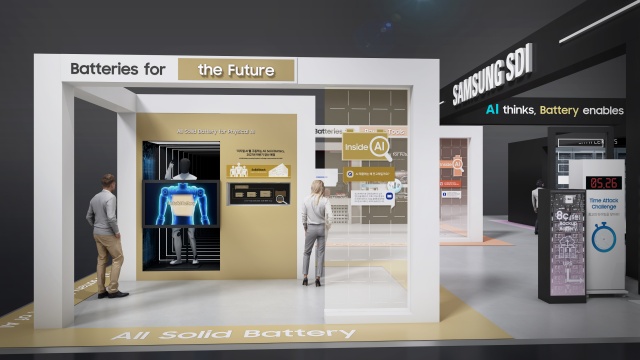
Samsung SDI, headquartered in Yongin, Gyeonggi-do, is a major South Korean battery and materials manufacturer with decades of EV and ESS cell production. In March 2026 it publicly unveiled its first pouch-type all-solid-state battery prototype designed specifically for humanoid robots and other "physical AI" systems, aimed at fitting a robot's tight chest-cavity space while handling the high current spikes of dynamic movement and supporting up to roughly 8 hours of continuous operation. Samsung SDI has also signed an MOU with Hyundai and Kia to co-develop robot battery technology.
Panasonic Energy, a Panasonic Group operating company headquartered in Osaka, is one of the pioneering makers of cylindrical lithium-ion cells (18650, 2170, 4680 formats) supplying Tesla and other EV/robotics makers, with major cell plants in Nevada and a new De Soto, Kansas gigafactory. Panasonic has publicly stated that its solid-state battery development is targeted first at humanoid-robot and drone applications, citing high manufacturing cost versus EV cells. Humanoid-specific supply deals have not yet been publicly confirmed for Panasonic, unlike LG Energy Solution and CATL.

Molicel, the brand of E-One Moli Energy Corp. (part of Taiwan Cement Corporation Group, tracing back to a 1977 UBC physics-lab spinout in Canada), specializes in ultra-high-power cylindrical 18650/21700 lithium-ion cells with very high continuous and peak discharge rates. Its cells are widely used in drones, eVTOLs, power tools, and motorsports where burst power-to-weight matters, and the high-drain INR-21700-P50B cell (5.0Ah, up to 100W discharge) has specifically been adopted for humanoid-robotics applications requiring rapid power delivery for joint actuators.
Amprius Technologies (Nasdaq: AMPX), headquartered in Fremont, California, was founded in 2008 to commercialize silicon-nanowire anode battery research from Stanford University. Its SiCore and SiMaxx cell platforms achieve among the highest commercially available lithium-ion energy densities (up to ~450-500 Wh/kg), and the company ships these high-energy, high-power cells to drone, UAV, eVTOL, and unmanned-ground-vehicle manufacturers — the same high-density mobile-robotics niche relevant to untethered humanoid platforms, though no humanoid-specific supply deal has been publicly disclosed.