Hands & Dexterous End-Effectors
Dexterous hands and end-effectors are the terminal manipulators that let humanoid robots grasp, hold, and manipulate tools and objects built for human hands. They combine multiple actuated fingers with tendon, linkage, or direct-drive mechanisms and increasingly integrate tactile and force sensing to approximate human-level grasping versatility. Achieving human-comparable dexterity, durability, and payload at reasonable cost and weight remains one of the hardest open engineering problems in humanoid robotics.
Manufacturers
5 companies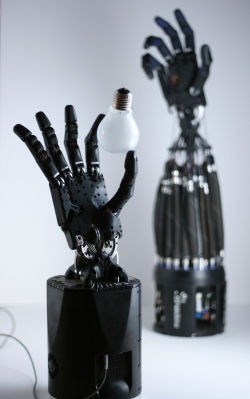
Shadow Robot Company is a London-based robotics firm, active since the late 1980s, best known for the Shadow Dexterous Hand, a tendon-driven anthropomorphic hand that closely reproduces human hand kinematics and dexterity. Its hands are used across research and industry, including by NASA, Bielefeld University, Carnegie Mellon University, and EU research consortia, and the hand was notably used by OpenAI in its Dactyl robotic manipulation research. Shadow also builds teleoperation glove systems that let a human operator's finger movements be mirrored in real time by the robotic hand.
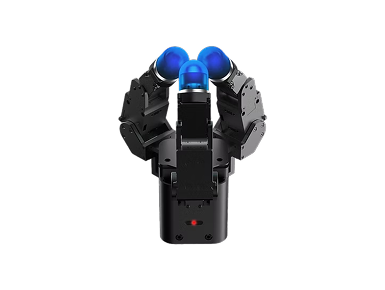
Wonik Robotics, part of the Wonik Group, manufactures the Allegro Hand, a four-fingered, torque-controlled robotic hand originally built on technology licensed from the Korea Institute of Industrial Technology (KITECH). The Allegro Hand is widely used as a low-cost, research-grade manipulation platform at universities and robotics labs worldwide, and its current V5 generation adds omnidirectional tactile fingertip sensing aimed at humanoid and industrial manipulation research.

SCHUNK is a long-established German family-owned manufacturer of gripping systems and clamping technology, founded in 1945, with a large industrial automation and robotics component portfolio. Its SVH 5-Finger Hand is a servo-electric, anthropomorphic five-finger gripping hand with nine drives and twenty mechanically coupled joints, fully integrated control electronics in the wrist, and grip forces up to 1200 N, designed to reproduce the size, shape, and mobility of a human hand for human-robot interaction and service robotics. In 2017 it became the first gripper of its kind certified by the German DGUV for collaborative (cobot) operation.

PSYONIC is a bionics company founded in 2015 by Dr. Aadeel Akhtar that developed the Ability Hand, originally a multi-touch-sensing prosthetic hand and now also marketed as a robotic end-effector for humanoid and industrial robots. The same Ability Hand platform has been integrated onto Apptronik's Apollo humanoid robot, with demonstrations at a Mercedes-Benz facility, and PSYONIC lists NASA, Meta, Apptronik, and Sanctuary AI among its early robotics research clients. ABB Robotics has also partnered with PSYONIC to explore using human grip and touch data captured by the Ability Hand to train robotic arm manipulation.

Inspire Robots is a Beijing-founded (2016) manufacturer of micro linear servo actuators and dexterous robotic hands, credited with China's first commercially mass-produced dexterous hand. Its RH56 series (including the RH56E2/RH56DFTP, RH56BFX, and RH56DFX variants) uses linear-drive tendon actuation with integrated force sensors to deliver five-fingered, human-scale grasping, and the RH56DFTP variant is specifically built and sold as a compatible end-effector for Unitree's G1 and H2 humanoid robots.